“Google Account Strategists” present themselves as experienced support reps to help your business grow with Google Ads. But they’re not.
Despite the aggressive tactics these reps use to convince you to apply their recommendations, following their advice can cost you.
In this post, we unmask who these Google Ads reps really are, how they are actually incentivized and why you generally should not engage with them.
The Illusion of the ‘Free Google Ads Expert’
If you run Google Ads for your business, you’ve probably received an email or call from someone at Google claiming to be your “Dedicated Account Strategist” (or a similar title). The email often comes with an urgent-sounding subject line like “Quick Fix in Your Google Ads Account”, “Account Verification” or other scare tactics related to your campaigns (see more examples below).
The rep will tell you they have customized insights to improve your performance and will try to schedule a quick call to review your account.
It sounds like harmless advice: a free expert assigned by Google to help your business grow. But in reality, it’s largely a sales pitch designed to persuade you to apply the same misguided Google recommendations that can derail your campaign.
Who are These Reps, Actually?
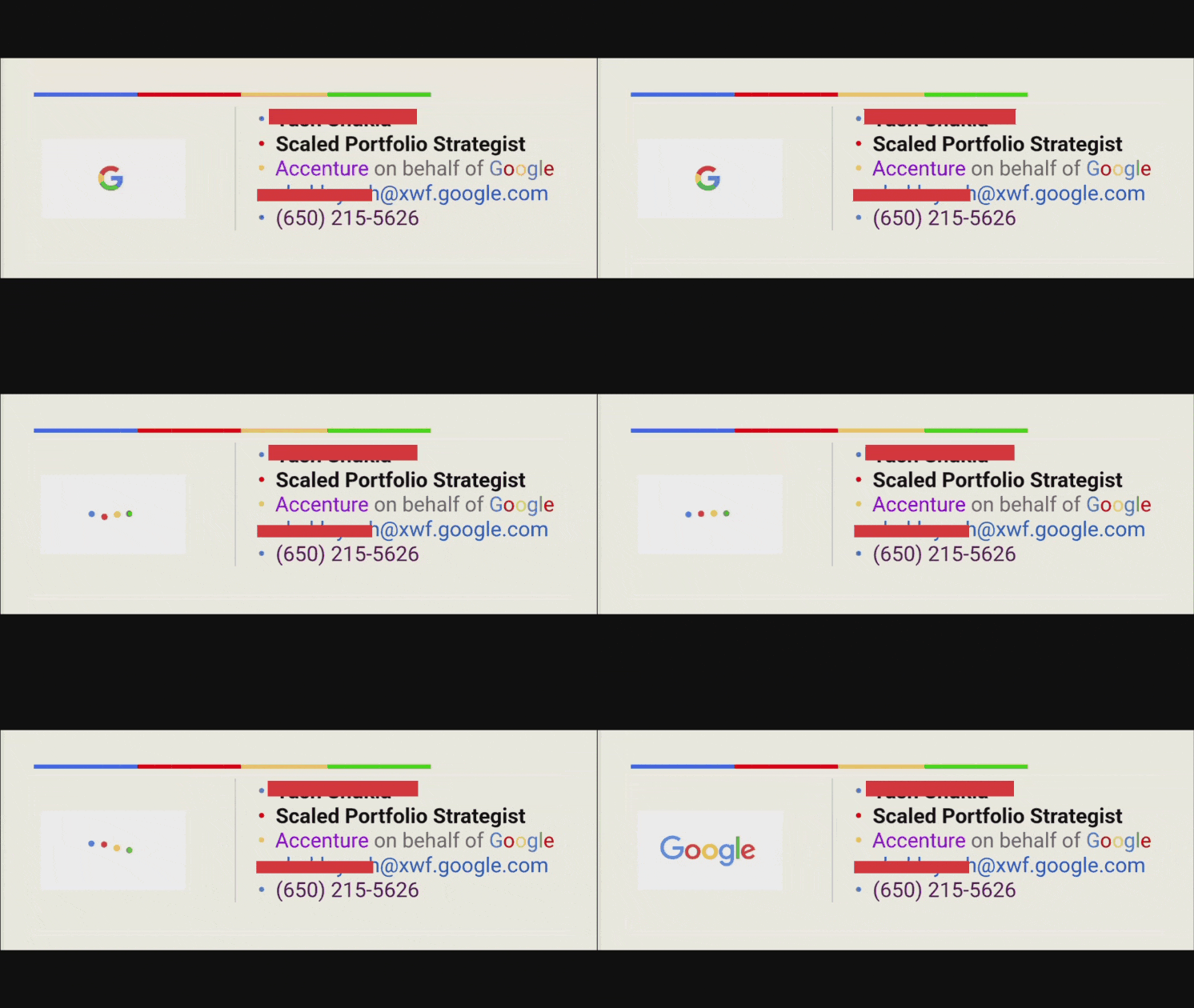
Despite the Google logo in their email signature, the vast majority of these strategists are not actual Google employees. They are Google’s third-party contractors working for massive global outsourcing firms like Accenture, Teleperformance, WNS and others.
If you look closely at their email addresses, you’ll often spot an @xwf.google.com domain, or a small disclaimer buried at the bottom of their signature that reads: “Accenture on behalf of Google.”
Very often, these reps are entry-level workers reading from corporate scripts. If you’re spending more than $10,000 a month in Google Ads, then these reps occasionally are actual Google employees – but even then, the tactics and strategies are similar and should be avoided.
Follow the Money: How They are Incentivized
These reps are not measured on how much money your business makes. They are measured on “adoption rates”—specifically, getting you to implement specific campaign strategies or to simply click “Apply” on Google’s automated recommendations.
They are tasked with pushing Google’s current agenda at any given time, which can include:
- Enabling AI Max
- Transitioning your budget to Performance Max (PMax) campaigns
- Enabling Display network ads or Search Partner Network (SPN)
- Switching your precise keywords to “Broad Match”
- Uploading customer lists
- Turning on “Auto-Apply Recommendations” (AAR)
- Increasing your daily budgets
Their ‘Sales Pitch” is Often Insidious

Once you agree to have a brief call with a Rep, or to accept their “insights” by email, it opens the door for them to start earning incentives based on certain changes in your account (whether you make them or the Rep does – and we’ve heard horror stories of Reps making unauthorized changes in advertisers’ accounts).
In their emails, some Reps will say, “We aren’t here to simply increase your budget,” which can be true. But that doesn’t mean their recommendations are harmless. The Reps are incentivized for much more granular adoptions – and, increasingly, they are desperate to do so.
Always remember: What makes Google the most money is rarely what brings in the highest quality, lowest-cost leads for a small or mid-sized business.
Why their Advice is Often Toxic for Small Budgets
The strategies these reps push are largely designed to control your ad spend, which is tremendously valuable for Google at scale across its massive pool of advertisers.
There are a few reasons why this is valuable for Google:
- Limitations of Search for Google’s profitability. For most advertisers, search is by far the most profitable ad type. But for Google, it’s unsustainable. Every new advertiser that bids on the same keywords increases the cost for everyone – and there are only so many spots on the page. As traditional Search volume is declining, that’s a big problem for Google. So it pushes broad targeting as much as it can.
- Google can’t force you to raise your budget. But it doesn’t have to. The company’s greatest money-making lever is to automate campaigns to ensure every single dollar of every advertiser’s budget is spent daily, while also making cost per click (CPC) appear more acceptable to the advertiser. To do this, they push their massive amounts of low-quality “inventory” (places where your ad can show, like obscure mobile apps and websites).
This is why reps aggressively push automated solutions like Performance Max (PMax), AI Max expansion and Broad Match keywords. These product types are endlessly scalable for Google.
How Exactly These Strategies Derail Your Campaign (Examples)
Google and its third-party reps are very good at making tools like AI Max sound appealing to an advertiser. But ultimately, these are just Google’s latest push for broad-keyword matching, dressed up as “AI” to sound smarter than traditional Search ads.
Let’s look at exactly how these rep’s recommendations can hurt:
- AI Max: Among PPC managers, we consider “AI Max” to be broader than broad-match. Google can use virtually any word on your website and target people searching for loosely related meanings of those words.
- So instead of targeting a desirable keyword like “Luxury remodeling company near me” your ads show for something like “bath tub fix” or even a search for a competitor’s website.
- It can even change your ad to match the user’s query. So your ad will say “Bath tub repair” when that’s not a service you offer at all.
- Performance Max: PMax can do the same wasteful keyword-matching and ad automation as AI Max (with asset customization enabled). But also, it can spend your budget on virtually worthless clicks on endless other websites and mobile apps.
- PMax is also notorious for generating fraudulent ad clicks and spam form submissions (which artificially inflate your conversion rate).
- Same with Display Ads, Demand Gen and Search Partner Network.
- Broad Match keywords: Broad match produces cheap clicks from keywords that are often completely irrelevant to your target keywords.
- So instead of targeting a keyword like “Limo service near me” your ads might show for someone searching for a “car rental.”
- In the most extreme examples, we’ve seen Google try to show our clients’ ads for searches for competitors’ phone numbers. In other words, someone searches Google accidentally for “777-555-1234” and then Google loads our client’s ad. And since Google also controls which headline appears, all the user sees sometimes is a “call” button – so they click to call, thinking they’re calling a car rental company. End result: wrong number and client’s budget (and time) is wasted – and depending on the call duration, it might be tracked as a conversion anyway.
- Ad Strength & Optimization Score improvements: Reps will often point to low scores in these areas, but it’s another deceptive scare tactic.
- Neither is a true performance indicator. Instead, they are largely a measure of how many of Google’s recommendations you’ve adopted.
- In many of our accounts, the reasons that result in a client’s low “Ad Strength” – like pinned headlines, as one small example – are what actually drive their campaign success, generating the highest-quality leads (and fewer unwanted duds).
- “Errors” with GA4, GTM and Enhanced Conversions: Reps often deceptively claim an “urgent need” to upgrade tracking, even when everything is properly configured.
- Some reps seem to use this tactic like a trojan horse to get an advertiser’s attention, successfully book a call and then get the go-ahead to implement the other strategies above.
- To be clear: proper tracking is essential for Google Ads campaigns. But this is often just another tactic that reps use to get their foot in the door.
- PMax is also notorious for generating fraudulent ad clicks and spam form submissions (which artificially inflate your conversion rate).
These are just a few examples.
Yes, it’s true that some campaign tools like AI Max and PMax have some newer controls to help limit unwanted clicks. But in our experience, these settings sometimes offer the illusion of control while Google continues to force your ads onto irrelevant search terms and low-quality partner sites.
The Massive, Negative Impact for Small Advertisers

For large e-commerce brands with 5- to 7-figure monthly budgets, implementing some of a Rep’s strategies will not wreck a campaign.
But for smaller advertisers—those spending less than $10,000 per month—these bad decisions can be extremely costly.
- Ads show up for completely irrelevant searches.
- Your budget gets wasted on bad clicks.
- You hit your daily limits before the algorithm ever figures out what a good lead looks like.
In short, you burn through your budget with nothing to show for it.
Is All Their Advice Bad?
No, not necessarily – and that seems to be part of the strategy too: mixing the incentivized recommendations with smaller, completely harmless tips, such as best practices for adding image assets or access to beta features and policy updates.
One rep who tried repeatedly to schedule a call told us that our client’s logo asset needed to be replaced. We checked – it was fine.
When pressed, the rep would not answer questions about the logo recommendation and instead pushed their other recommendations.
Shady Tactics & Known Horror Stories

Because these reps have quotas to hit, their tactics have become increasingly aggressive in recent months.
At MarlinSEM, this aggressiveness is the worst I’ve seen in my nearly 20 years using Google Ads.
We’re fielding multiple calls and emails every day, across every account we manage. Even when we politely decline and ask to be removed from their lists, this seems to only trigger more emails and calls (see examples below).
Here is just a sampling of some of the scare tactics that they use:
- “Ads are not showing 80-90% of the time.” – A vague claim that does not mention which campaign, ad group or keywords it’s referring to, as well as whether it’s impression share due to budget, rank or other audiences entirely.
- “Time-sensitive changes” in Google Ads that, “if not addressed prior to that date, campaign performance will likely be affected.”
- Warnings to “future-proof” accounts from non-specified future changes.
- “I spotted a few things I think we could tweak to really boost your results.”
- “I’ve already peeked at your account and have a few thoughts on how we could really make things pop.”
To be fair, not all reps’ emails use scare tactics. Most simply present the opportunity to discuss goals on a phone call, before providing specific recommendations.
Lately, the Tactics Have Bordered on Desperation
- Reps are contacting my personal mobile device and home phone – and it’s not clear where they’re getting those numbers.
- When we don’t respond as an agency, reps are contacting our clients directly, leading them to believe there’s something wrong with their campaigns even when in fact performance is excellent.
- Some reps have also been leaving completely blank voicemails over a minute long. No message. Just silent, sometimes with background chatter. Is this just the nature of the calling system they use, or it possible that some reps are deceptively hitting their quotas by making it appear they’ve made successful contact with us? I don’t know, but it’s very questionable and it ultimately distracts us from the real work we do for our clients.
Don’t Just Take Our Word for It
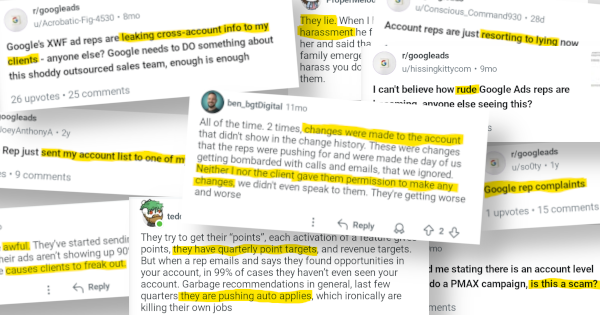
Industry forums like Reddit are filled with horror stories from business owners and PPC managers who have been convinced to implement reps’ advice – only to see campaign budgets quickly burned on irrelevant traffic and campaigns thrown way off track. In extreme cases, campaigns were derailed so far that advertisers quit Google Ads altogether.
Therein lies the problem: these reps don’t care about your profitability with Google. They only care about getting a paycheck. At least, that’s how it appears when they use these shady tactics.
The Relentless Aggression: A Peek Inside My Inbox
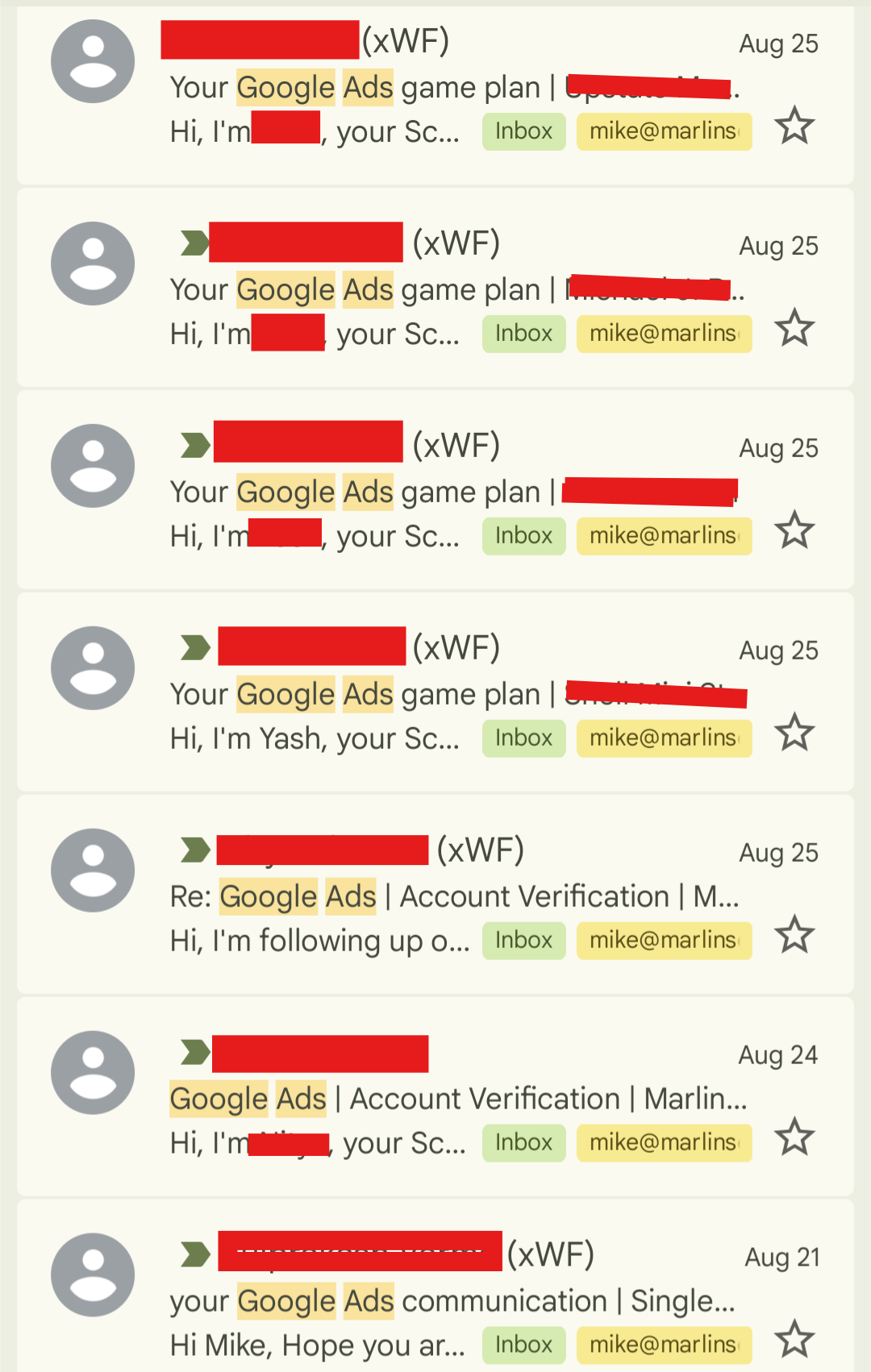
If you want to know just how aggressive this program has become, just peek in my agency inbox. On any given day, I am bombarded by multiple different “Scaled Portfolio Strategists.”
It borders on harassment. Recently, after receiving a barrage of emails from a rep, I politely replied: “No, thank you. Please discontinue contacting us regarding these accounts and remove us from your list.”
Instead of respecting the opt-out, the rep proceeded to email me multiple times daily for the next week, demanding that I “acknowledge” their attached spreadsheet of recommendations, followed by emails asking, “Did you get my previous email?”
In recent weeks, we have been receiving emails and calls from multiple reps vying for the same advertisers’ accounts simultaneously.
These reps don’t want to strategize. They want to check a box.
Does Google Care about This?
I won’t mince words: these reps have become slimy.
Does Google realize? Do they know how bad it is?
Those are questions that many of us in the PPC world discuss frequently. Many longtime PPC managers (and former Google Account Reps) say that Google is fully aware. The company needs to hit its own, aggressive numbers, so they turn a blind eye.
But I’m not so sure. As someone who lives and breathes Google Ads, and the entire Google ecosystem of products—I tend to believe the company’s decision-makers don’t really have granular insight into the tactics these reps are using. If they knew how bad it was, and how it tarnishes Google’s reputation, I think they would care enough to make some changes. I hope so, anyway.
Why We Have a Strict ‘Do Not Engage’ Policy

At MarlinSEM, part of our job is acting as a shield between your credit card and Google’s aggressive sales machine. We work for you—our clients—not Google.
We make optimization decisions based on actual conversion data, lead quality, deep knowledge of Google Ads and your specific business goals—not a standardized checklist pushed down from a call center.
In recent months, engaging with these reps in any way, such as replying to an email, seems to activate some kind of partial acknowledgement of the rep’s “insights,” potentially even counting toward a rep’s preliminary incentive quota (we can’t verify this yet, but we have our suspicions).
We have participated in plenty of these calls, for accounts of all sizes, to know that the recommendations are not in our clients’ best interests—particularly clients with smaller budgets.
The Differences: Independent Specialist vs. A Google Rep
| What You Need from a Google Ads Partner | Independent Specialist | Google Rep |
| Works in your best interest, not Google’s | ✅ | ❌ |
| Extensive hands-on Google Ads experience | ✅ | ❌ |
| Focused on generating high-quality leads, not just clicks | ✅ | ❌ |
| Cares how efficiently your budget is spent | ✅ | ❌ |
| Incentivized to improve your actual ROI | ✅ | ❌ |
| Knows your business, services, margins and customers | ✅ | ❌ |
| Builds strategy around your specific goals | ✅ | ❌ |
| Makes recommendations based on your conversion and lead-quality data | ✅ | ❌ |
| Can tell you when a Google recommendation isn’t right for your account | ✅ | ❌ |
| Has no quota to hit for adopting Google products/features | ✅ | ❌ |
| Provides an independent opinion of Google’s recommendations | ✅ | ❌ |
| Accountable for your long-term campaign performance | ✅ | ❌ |
| Prioritizes your profitability over spending your entire budget | ✅ | ❌ |
Frequently Asked Questions
1) Do Google Account Strategists work for Google?
Some account strategists are Google employees, but the vast majority are third-party contractors working for outsourcing firms like Accenture, Teleperformance and WNS, hired by Google. Despite having Google email addresses, these contractors are not employed directly by Google and typically do not have experience managing Google Ads campaigns.
2) Should I Follow the Advice of Google’s Account Strategist?
Advertisers should proceed cautiously with Google’s recommendations, whether provided by a Google Account Strategist or by the Google Ads platform. Account reps are incentivized to push account changes that typically only benefit Google, not the advertiser. Advertisers should speak with an experienced, independent Google Ads specialist to understand how each recommendation will affect performance.
3) How is a Rep’s Advice Actually Bad?
Most commonly, Google and its account strategist contractors will recommend strategies that target a broader, lower-intent, sometimes irrelevant audience. These changes can indeed increase traffic, but typically budget will be wasted on unwanted clicks that produce fewer and/or lower-quality leads.
4) How Can I Increase My Optimization Score?
Google’s Optimization Score is not a true metric for account performance or potential. It is merely a measurement of how extensively you’ve applied Google’s recommendations – recommendations that typically should be avoided, especially for smaller advertisers spending less than $10,000 a month on Google Ads.
The Bottom Line
Google Account Strategists seem helpful, but ultimately they are third-party salespeople that serve their own interests and Google’s—not yours as the advertiser. If a Google rep reaches out to you directly, politely decline or ignore them entirely. The best way to protect your ad spend is to use the advice of a dedicated professional who actually works for you, not the platform selling you the ads.

![How to Use Google Ads for Limo Services [Updated 2026]](http://marlinsem.com/wp-content/uploads/2024/01/limo-company-advertising-google-ads-2025-500x383.png)