
When Rebecca first called me (I am omitting her last name at her request), she made one thing very clear: her Google Ads campaigns were burning money, and if she couldn’t turn things around, her therapy business would be at risk.
But it was exactly that confession, among other reasons, that gave me reservations about managing her Google Ads account.
After our initial conversation, I wasn’t convinced that my services were a good fit for Rebecca, a longtime California therapist who was struggling to attract new clients with her campaigns. But regardless of my hesitancy, I told her I’d be happy to look over her Google Ads account for free. I would, at the very least, point her in the right direction, even if we didn’t end up working together.
Fast forward a year later, Rebecca’s therapy business is thriving once again, thanks to a campaign restructuring and a successful, ongoing working relationship that reveals a lot about how I approach Google Ads management (and life in general).
The red flags that almost scared me away

When I first spoke to Rebecca, several challenges became apparent. Her Google Ads budget was tiny – only $300 a month. Ordinarily, I’m fine with small budgets – but her campaign was largely failing to produce a single good call.
She had to fix things ASAP, she told me, or it could mean the decline of her business altogether.
There were several potential obstacles embedded within that context that made me hesitant.
- For one, in my view, it didn’t seem to make financial sense for her to pay for campaign management, which would be nearly as much as her ad budget.
- Second, the stakes were high. The fate of her therapy business was on the line, and typically that’s not a good starting point for my PPC services. With any client, I never want to be in a position in which my services are the deciding factor for their business. So when any company calls me that is on the verge of failure, there’s usually not much that I (or any single person) can do to turn things around, regardless of the campaign strategy.
Additionally, the circumstances around which Rebecca contacted me—even the contact method itself, a phone call—gave me pause initially, as I explain below.
An unexpected phone call
When Rebecca called me in early 2025, she told me she’d been referred to me by someone who saw I specialized in Google Ads for small businesses.
Ordinarily, this is great – many of my new clients find me by word of mouth. But these days, it’s increasingly rare for prospective clients to reach out by phone (and in fact, a quirk in my process at MarlinSEM is that we operate almost exclusively by email, for better efficiency and clarity).
When someone calls by phone, without knowing much else about Google Ads or PPC management, it’s often a reliable sign that they probably won’t move forward once they learn the finer details. There are many misconceptions about Google Ads and how it works. When I go over some of the potential challenges with prospective clients—transparency that is a fundamental part of my process—some decide it’s not for them – and that’s fine.
So my hunch, initially, was that Google Ads probably wouldn’t be a good fit for Rebecca. I was prepared to politely pass on the opportunity to manage her account.
But I’m so glad I didn’t.
What I found in her Google Ads account

When I spoke further with Rebecca, I discovered she was already astute about Google Ads. But it simply wasn’t working for her, and she wasn’t sure why.
This was enough for me to want to take a closer look. I was motivated to help her turn things around, even if she wouldn’t need my services after an initial account audit.
It only took a couple of minutes to identify some critical issues with Rebecca’s account.
The main problem was that her account was using outdated, inefficient campaign types with misconfigured conversion tracking that was delivering irrelevant traffic, bots and spam.
But I could see why Rebecca was confused about the lack of results. In her defense, she and her previous account managers had simply been applying the advice that Google itself had recommended over the years.
Small campaigns, big problems
Rebecca’s $300/month ad budget was split between two campaigns:
- Performance Max (PMax): Google’s AI-powered all-channels option.
- Smart campaign: The barebones, limited-visibility campaign previously known as AdWords Express.
This setup alone was problematic, because both campaign types are notorious for going off track. Plus, they provide limited visibility over how the advertiser’s budget is spent (especially back in 2025, before Google offered better reporting for PMax).
But there were a few other red flags, as well.
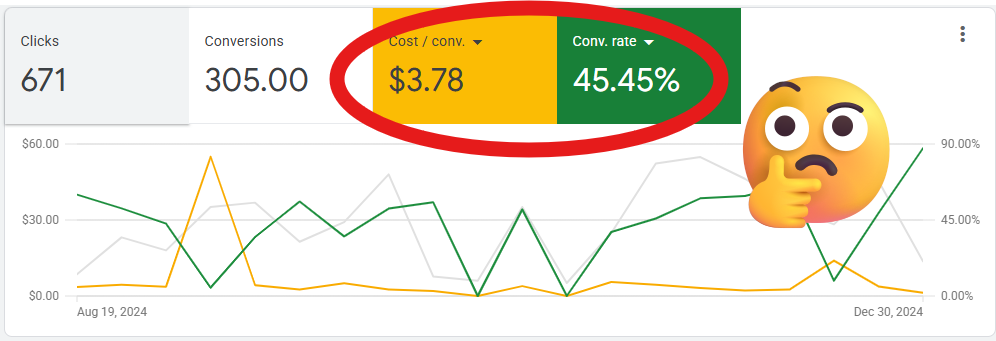
The Performance Max campaign appeared to have a 45% conversion rate at times, sometimes generating as many as 6 responses a day from a $10 per day budget. This just wasn’t possible.
I asked Rebecca, “Are you getting a lot of spammy form submissions?” She confirmed she was – several a day, often with very strange email addresses, and none of them would respond to her when she tried to contact them.
Her campaigns hadn’t produced a single new client in months
It was clear that her Performance Max campaign was producing spam, driven by bots clicking on her Display ads on third-party websites (which is one reason why I rarely recommend Display ads for advertisers with limited budgets).
This was partly due to the fact that her conversion tracking was not set up properly, which was inadvertently sending inaccurate signals to Google, making the problem worse (in essence, each spam form submission was telling Google to put her ads back on those same spammy websites).
I estimated that roughly half her budget was being spent on that fraudulent traffic. The other half was being spent almost entirely on unwanted clicks from irrelevant search terms, due to Google’s broad keyword matching.
Here are just a few examples of the bad keywords that were wasting her budget:
- Antidepressants
- Treatment centers
- Signs of depression
- Anxiety medication
- Mental health quiz
- Hypnosis
For any therapist using Google Ads, especially at this budget, every dollar should have been going toward searches explicitly for a therapist. But that’s not what was happening. Google’s keyword targeting was way off track – common for Pmax and Smart campaigns.
Again, this wasn’t Rebecca’s fault. She had simply followed Google’s recommendations – but those recommendations were misguided.
More potential challenges, despite the clear path for improvement

While it was clear what needed to be done to fix the account, I told Rebecca that I couldn’t guarantee that it would deliver the results she hoped for.
A major potential challenge: the high costs per click (CPC) for therapist-related keywords, especially with national advertisers like BetterHelp spending millions in the same space.
At the time, the CPCs ranged from $6 to more than $25 per click for terms like “couples therapist near me.” Rebecca’s budget was $300 per month, or approximately $10 per day on average. By improving the keyword targeting, we would be significantly decreasing the traffic she was getting from her campaigns and significantly increasing the CPC.
In other words, at that budget, she might only get 1 click a day, or none at all on some days.
Transparency first: addressing the obstacles
I explained all of this to Rebecca. To me, providing this transparency is one of the most important aspects of my Google Ads management, because advertisers should always know what to expect – even if it means that my potential client decides not to move forward.
I explained to Rebecca my recommended strategy (more on that strategy below), along with the potential obstacles:
- The high CPCs might mean very few visitors a month
- Potential conversion rate might be only 8%-12% (around 1 in 10 visitors)
- The actual rate of leads converting to paying clients would naturally be even less
The potential for success, despite the risks

I emphasized that, despite the challenges, my recommended strategy was still the best approach for her campaign. Every penny would go toward the highest-intent searches: people who were actively, explicitly searching for a therapist.
I expected Rebecca to pass. But she was surprisingly enthusiastic.
She reiterated that her campaign wasn’t producing any results currently, “So let’s try it.”
What surprised me most was how appreciative Rebecca was of the conversation alone. She understood from our conversations that I was looking out for her and how her money would be spent.
I want to pause on that point for a moment, before I dig into the campaign strategy.
Why my approach to PPC is different
Many of my colleagues in the PPC world would question my approach here. Why was I devoting so much effort and time to explain all the potential challenges and risks? Did I want the account or not?
Therein lies the difference between my approach and that of a larger agency: I am motivated by my clients’ success, first and foremost.
Whereas a typical agency account rep might purposely hide the potential risks (or worse, promise the world) merely to make the sale, I wanted Rebecca to know exactly what to expect and what to consider before giving Google another dollar.
I absolutely wanted to help Rebecca – and I appreciated her eagerness to hire me as her Google Ads manager. But simply acquiring a new client for MarlinSEM is secondary to my core priority of helping a business owner to see a profitable return from their Google Ads spend (and to not be misguided by Google’s own profit-driven recommendations).
I once explained this approach to another client, the owner of a moving company in New Jersey. And he responded, “I get that – because if I make money and increase my budget, that helps you too.”
Sure, that’s technically true – my management fee structure is designed to increase as businesses increase their ad budget over time, because of the increased time required for larger accounts. But that’s really not the underlying motivation, as strange as that might sound to some clients.
I’m simply not motivated by profit. I’m looking to help.
But why?

A weird thing happened over the 20 years that I’ve been helping businesses with digital marketing. Early on, the natural mantra was: the more clients, the better. Grow bigger, faster.
But over the years, I realized that working with the right clients was so much more important and rewarding than the volume of clients.
To me, it’s infinitely more valuable to work with clients in a collaborative partnership that’s built on mutual respect and understanding – rather than chasing every new account just for the sake of growth.
Evolving priorities in my approach
This view became even clearer to me over the last few years.
After a pandemic, the death of several family members and a personal cancer diagnosis, my approach to PPC management has continued to shift. I discovered how much I deeply value the people and businesses I work with. I work hard to help them succeed, because nothing is more rewarding—to both ends of this partnership—than when my clients and I are aligned toward the common goal of their success.
When these goals aren’t aligned, it only creates unnecessary friction and frustration for everyone involved.
And frankly, life is too short for any other approach. Why chase after accounts in which there are red flags or situations that I know I won’t be able to help with? Why settle for transactional business deals when I could be investing that time into the people and businesses I truly care about helping?
That is why I spend so much time helping prospective clients understand the potential challenges and risks before moving forward.
In defense of the big-agency mantra

And for the record, I don’t hold it against larger agencies for their approach. That’s just how they’re designed. They’re too big to take on small Google Ads accounts like the ones I manage. There’s not enough margin to be profitable from small management fees alone.
Agencies make their biggest profits from selling website redesigns, landing pages and bloated campaign types like Performance Max. They have multiple layers of teams, account managers, sales executives and marketing managers, all geared toward the goal of squeezing as much budget as possible from every advertiser.
That’s just not my thing.
I’d much rather help a client with a $300/month budget if it means they can have success with Google Ads and know that the work we’re doing together is making a real, tangible impact on their business.
This brings me back to Rebecca.
A revamped Google Ads strategy
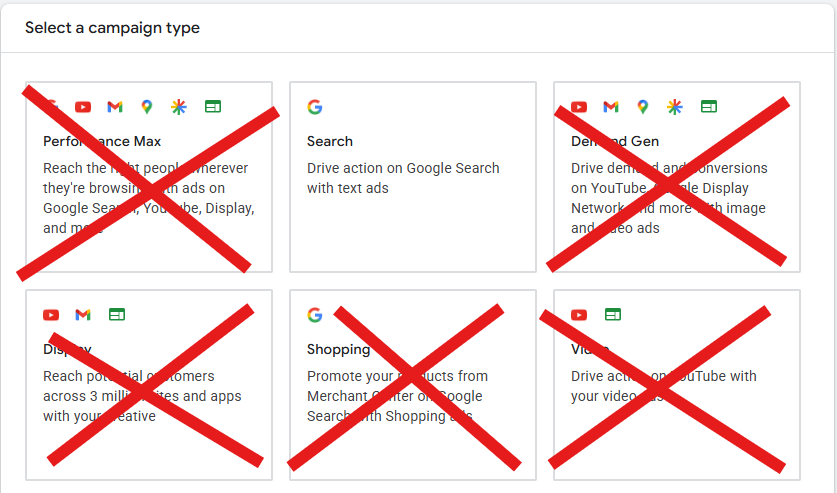
Visually, Google intentionally makes Search campaigns look inferior to other types, but it’s the best option for most small advertisers.
Rebecca’s Google Ads certainly needed reworking, but ultimately the new path forward was relatively straightforward. In fact, this is the same core strategy I would recommend to almost any therapist using Google Ads.
The new plan:
- Immediately stop Performance Max and the Smart campaign.
- Launch a new Search campaign with a “Maximize conversions” bid strategy to start.
- Focus tightly on searches for “therapists,” “therapy near me” and similar variations (Phrase match at first).
- Disable “Search Partner Network,” “Display Network” and all of Google’s auto-apply recommendations.
- Implement accurate conversion tracking for all response activity, including:
- Form submissions
- Calls from ads (click to call)
- Calls from website (Call forwarding with tracking)
- Email address clicks
- Update the website to emphasize free consults and methods of contact (conversion rate optimization).
To be clear: in terms of a Google Ads setup, this isn’t very complex. But it’s absolutely the best approach for a therapist with a limited budget – and most other small advertisers as well.
How we addressed two early concerns
Two potential challenges I addressed with Rebecca were:
- High CPCs for therapist keywords
- Rebecca’s focus on teletherapy, rather than in-person appointments
Since Rebecca does teletherapy, this allowed us to expand her location targeting to the entire state of California where she was licensed. This helped to keep CPCs lower, because it opened the targeting to a much wider audience. (Local targeting is naturally more expensive because there is lower search volume. This makes those keywords much more competitive.)
But when targeting statewide, we also had to make her ads clearer that in-person therapy wasn’t offered. Otherwise, budget would be wasted on clicks from people looking for a local, in-person therapist in their community.
To address this, we emphasized teletherapy in nearly every headline and description option in the Responsive Ads (with different phrasing like “Therapy from Your Home,” “Convenient Teletherapy” and so on).
The results

Despite all my initial hesitations and the potential challenges, Rebecca’s new Google Ads campaign started driving new leads and clients within days.
In the first month, her campaign generated 7 leads, for an average cost per conversion of about $43. Continued success over the following months led her to continually increase her ad budget, driving more conversions (and ultimately giving Google better data to better optimize her campaign targeting).
- With continued management, we were able to push the average cost per conversion as low as $26 some months.
- Aggressive negative keyword additions have also been critical to preventing Google from getting too broad with the keyword matching.
- Left unchecked, we found that Google was trying to occasionally show our ads for irrelevant searches like “physical therapy,” physicians and religious counseling, among others.
- We also made sure to block terms for forms of therapy that were not applicable to Rebecca’s services.
Over time, we also experimented with custom audience targeting to improve the lead quality. These strategies helped Rebecca turn more of these responses into long-term clients.
The larger picture
Working with Rebecca has been a case study for a truly collaborative Google Ads partnership – one that I’ve valued tremendously.
As I tell all my clients, I can only take partial credit for the success of their Google campaigns. I help their ads reach the right people and keep their campaigns on track, based on what I’ve learned over the past two decades of using Google Ads. After that, it’s largely up to my clients (and their websites) to compel people to take the next steps.
But Rebecca is always quick to give me credit anyway, insisting that I’ve helped turn her therapy business around. She’s appreciative of the work that goes into her campaigns, and I’m deeply appreciative of that perspective, even if I see it as just holding up my end of the partnership.
The success of this campaign has been a refreshing reminder to me that my approach to client relationships is what truly moves the needle for the businesses I work with. With transparency, the right strategy and a foundation of mutual respect, even the smallest budgets can make a measurable impact.


![How to Use Google Ads for Limo Services [Updated 2026]](http://marlinsem.com/wp-content/uploads/2024/01/limo-company-advertising-google-ads-2025-500x383.png)